What Adjustments Have You Made to Help Prevent From Making Perceptual Mistakes Over Again
What nosotros get incorrect about time
(Image credit:
Javier Hirschfeld/Getty Images
)
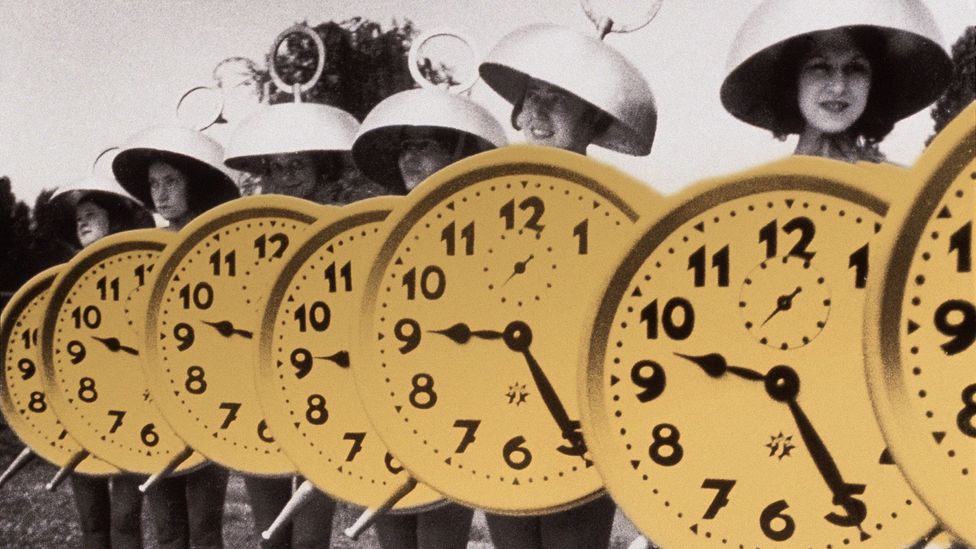
Most of u.s. tend to retrieve of time as linear, absolute and constantly "running out" – but is that really true? And how can nosotros alter our perceptions to feel ameliorate virtually its passing?
"Fourth dimension" is the most frequently used substantive in the English language. We all know what it feels like as time passes. Our present becomes the past as soon as it's happened; today shortly turns into yesterday. If you live in a temperate climate, each year you meet the seasons come and go. And equally we accomplish adulthood and across, we get increasingly enlightened of the years flashing past.
Although neuroscientists take been unable to locate a single clock in brain that is responsible for detecting time passing, humans are surprisingly good at it. If someone tells us they're arriving in v minutes, we have a rough idea of when to get-go to wait out for them. Nosotros have a sense of the weeks and months passing by. As a outcome, most of u.s. would say that how time functions is adequately obvious: it passes, at a consistent and measurable charge per unit, in a specific management – from past to future.
Of course, the human perspective of time may not be exclusively biological, but rather shaped past our culture and era. The Amondawa tribe in the Amazon, for example, has no word for "time" – which some say means they don't have a notion of fourth dimension every bit a framework in which events occur. (There are debates over whether this is purely a linguistic argument, or whether they actually practice perceive fourth dimension differently.) Meanwhile, information technology'due south difficult to know with scientific precision how people conceived of fourth dimension in the by, as experiments in time perception have only been conducted for the last 150 years.
You might also like:
- The pros and cons of the time-travelling mind
- Who will be remembered in 1,000 years?
- An effortless way to meliorate your memory
What we practise know is that Aristotle viewed the present as something continually changing and that by the year 160, the Roman emperor-philosopher Marcus Aurelius was describing time as a river of passing events. And in the Westward, at least, many would nevertheless identify with these ideas.
But physics tells a unlike story. However much time feels like something that flows in one direction, some scientists beg to differ.
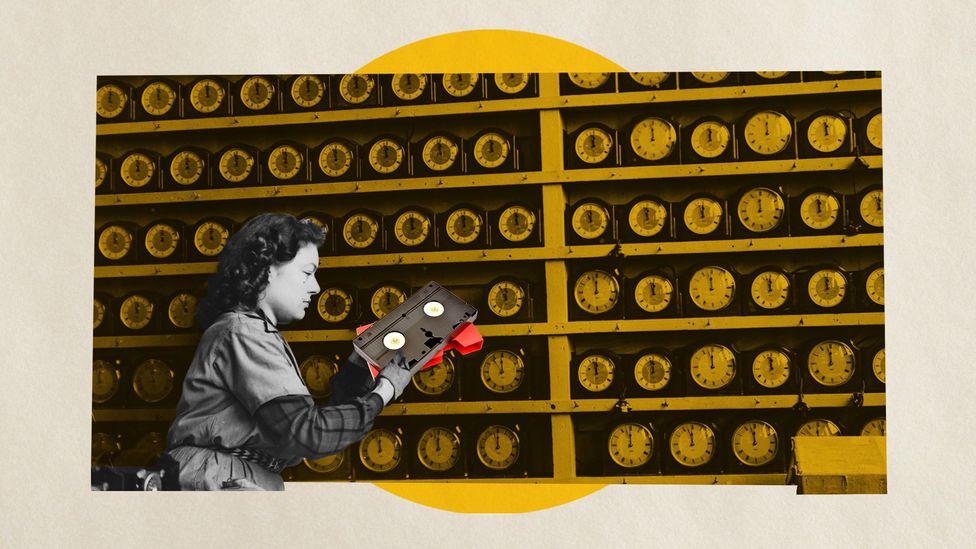
If memories were fixed like videotapes then imagining a new situation would be tricky (Credit: Javier Hirschfeld/Getty Images/Alamy)
In the last century, Albert Einstein's discoveries exploded our concepts of time. He showed us that fourth dimension is created past things; it wasn't in that location waiting for those things to act within information technology. He demonstrated that time is relative, moving more than slowly if an object is moving fast. Events don't happen in a set society. There isn't a single universal "at present", in the sense that Newtonian physics would have information technology.
Information technology is true that many events in the Universe can be put into sequential order – but time is non always segmented neatly into the past, the present and the futurity. Some physical equations piece of work in either direction.
A few theoretical physicists, such as the best-selling writer and physicist Carlo Rovelli take it even further, speculating that time neither flows, nor even exists. It is an illusion.
Of grade, although some physicists propose that time does not be, time perception – our sense of time – does. This is why the bear witness from physics is at odds with how life feels. Our shared idea of what the concept of "futurity" or "by" mean may not apply to everything everywhere in the Universe, but it does reflect the reality of our lives here on Earth.
Like the Newtonian thought of absolute time, however, our conventionalities in how time works for humans can too be misleading. And in that location may be a ameliorate approach.
Fake pasts
One aspect of time perception many of the states share is how we think of our own past: as a kind of giant video library, an archive we tin can dip into to retrieve records of events in our lives.
But psychologists accept demonstrated that autobiographical retention is not like that at all. Nearly of usa forget far more than than we remember, sometimes forgetting events happened at all, despite others' insistence that we were at that place. On occasion even the reminder does nothing to jog our memories.
As we lay down memories, we alter them to make sense of what's happened. Every time nosotros think a memory, we reconstruct the events in our heed and even change them to fit in with any new information that might have come to light. And it's much easier than you lot might think to convince people that they accept had experiences which never happened. The psychologist Elisabeth Loftus has done decades of research on this, persuading people they remember kissing a giant green frog or that they in one case met Bugs Bunny in Disneyland (as he's a Warner Bros character, and then this can't have happened). Even recounting an anecdote to our friends can hateful our retentivity of that story goes dorsum into the library slightly contradistinct.

People tin exist peruaded to "remember" events that never happened to them (Credit: Javier Hirschfeld/ Getty Images)
Another error nosotros brand is to assume that imagining the future is completely dissimilar from thinking about the past. In fact, the 2 processes are linked. We recruit like parts of the brain to reminisce or to moving picture our lives in years to come. It is the possession of our memories that permits united states of america to imagine a hereafter, remixing scenes to preview future events in a window in the heed. This skill allows us to make plans and to try out different hypothetical possibilities earlier nosotros commit.
These curious sensations occur equally a issue of the way our brains deal with time. A babe, with little by way of autobiographical memory, lives constantly in the present. She's happy. She's crying. She's hungry. She's miserable. A babe experiences all this, just doesn't retrieve dorsum to how cold it was last month or worry that temperature might drop again soon.
So gradually a toddler will begin to develop a sense of self. With that evolution comes an understanding of time, of yesterday as distinct from tomorrow.
Even at that historic period, though, imagining one's cocky in the future remains a claiming. The psychologist Janie Busby Grant found that if you ask three-year-olds what they might practice the following day, simply a third can give an respond judged to exist plausible. When the psychologist Cristina Atance gave small children some pretzels to eat followed by the option of more pretzels or some water, it won't surprise you to larn that, thirsty after eating the table salt, nearly chose h2o. Simply when she asked them what they would like to accept when they came dorsum the adjacent day, most still opted for water. (Adults chose pretzels, knowing that past tomorrow they volition feel hungry again.) Very pocket-sized children are unable to imagine themselves in a future where they might experience differently than they practise in this moment.
The experience of time is actively created past our minds. Diverse factors are crucial to this construction of the perception of time – memory, concentration, emotion and the sense nosotros have that time is somehow located in space. Our fourth dimension perception roots u.s. in our mental reality. Time is not only at the heart of the way we organise life, merely the way we feel information technology.
Of course, yous could argue that it doesn't actually matter whether we perceive time accurately co-ordinate to the laws of physics. On a daily basis, we can acquit on walking without needing to remember that, even so flat the world feels while you're on the ground, information technology is spherical. We still talk of the Sun rise in the morning and setting in the evening, even though we know that it is the World and not that the Lord's day that is moving. Our perceptions don't continue upward with the science – and we tin can merely create our everyday experience of the world using the senses we possess.

If someone asked you to imagine floating to work on a lilo, nearly of us would have no problem imagining it (Credit: Javier Hirschfeld / Getty Images)
Likewise, our perception of time is not something nosotros can choose to ignore. All the same much you learn about four-dimensional space-time, waiting for that delayed train is still going to feel longer than having luncheon with your friend.
Simply fifty-fifty if we can't change our perceptions of time, we can modify the way we think about information technology – and perhaps feel better almost its passing, and ourselves, every bit a result.
Fourth dimension for change
Instead of considering the past, present and future to be in a straight line, nosotros tin can look on our memories as a resource to allow us to call up of the hereafter.
This is crucial. Humans' power to time travel mentally, forward and back, is why we're able to do so many of the things that set us apart – such every bit programme for the hereafter or create a work of art. And the of import function that memory has to play within that isn't a new idea: Aristotle, for example, described memories not every bit archives of our lives, but as tools for imagining the futurity.
This means that what may accept seemed similar a flaw earlier – our difficulty to recollect the past accurately – is actually an advantage. If memories were fixed similar videotapes then imagining a new situation would be tricky. If I asked you to picture yourself arriving at your workplace adjacent Tuesday morning time non via your usual route, but instead floating on a lilo on a turquoise culvert lined with tropical flowers, past familiar buildings right upwardly to the front door of your function where your old schoolhouse friends will greet you with a cocktail, in an instant nigh of you volition be able to do it. (An exception is people with an unusual condition called severely scarce autobiographical memory.)
Your memory is so flexible that in an instant you lot tin can summon upwards your personally-recorded memories of the street where yous work, what it's like to lie on a lilo, the faces of your school friends, images of tropical flowers and cocktails. Yous not just locate all these memories which might be decades apart, but you then splice them together to invent a scene yous have never witnessed or even heard of before.
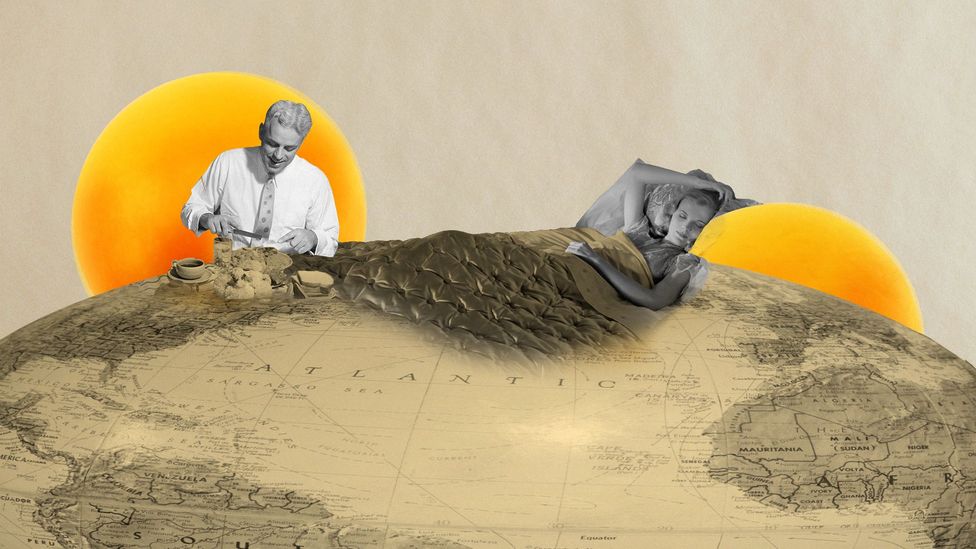
We still talk of the Dominicus rising in the morning and setting in the evening, even though we know it is the Globe moving (Credit: Javier Hirschfeld/Getty Images)
Cognitively, it sounds similar difficult work. In fact, the flexibility of our memories makes it fairly easy to do.
Then we shouldn't curse our memories when they let us down. They're fabricated to be changeable, in order that we can take millions of fragments of memories from different times of our lives and recombine them to give us countless imaginative possibilities for the hereafter.
In fact, when our memory for the past is damaged, and then is our power to remember nigh the hereafter. The neuroscientist Eleanor Maguire asked people to describe an imaginary future scenario in which they were continuing in a museum. Some said it had a domed ceiling. Others a marble floor. But people with amnesia were unable to suggest what it might look like due to our reliance on memory to permit us to think about the future.
Instead of thinking of our memories as a handy video archive, we can conduct in mind that our memory of an event might not be perfect – and accept that others might have very different memories of the aforementioned outcome.
Slowing downwards
There's one other thing we can practice. The single question I have been most frequently asked after writing a book on time perception is, how tin can nosotros dull time downwards?
Only I wonder whether nosotros should be careful what nosotros wish for. In middle age, the weeks and the years can experience every bit though they wink by. But part of our sense of fourth dimension passing is dictated by the number of new memories nosotros have fabricated. When you look dorsum on a busy holiday, fifty-fifty though it went chop-chop at the fourth dimension, in retrospect information technology can experience as though you were away for ages. This is because of all those new memories you made past spending a calendar week exterior your usual routine. If life feels as though it's going fast, this could be a sign of a life that is full.
Meanwhile, fourth dimension does feel as though information technology's going more slowly if you are bored or depressed or feeling lonely or feeling rejected, none of which we would want to seek out. Equally Pliny the Younger wrote in 105, "The happier the fourth dimension, the shorter information technology seems."
Simply if yous exercise want to shed that unsettling feeling on a Sunday evening that the weekend has whizzed by, there is something you lot tin practice: constantly seek out new experiences. Take upward new activities at weekends and visit new places, rather than heading for the same pub or movie theater. All this fun means the fourth dimension volition wing in the moment – but because you will lay downwards more than memories, when you get to Monday morn, the weekend will have felt long.
As Pliny the Younger wrote in AD 105, "the happier the time, the shorter information technology seems" (Credit: Javier Hirschfeld/ Getty Images)
Some routine, of class, is unavoidable. But if yous tin can create a life which feels both novel and entertaining in the nowadays, the weeks and years will feel long in hindsight. Even varying your route to piece of work tin make a difference. The more memories you tin create for yourself in everyday life, the longer your life will feel when you look dorsum.
The mode nosotros experience time in our minds is never going to match up with the latest discoveries in physics. Nosotros all know what the passing of fourth dimension feels like. Although we can't alter the way our brains perceive time, at that place are ameliorate ways we can start to think about it. But even and then, the fashion it warps in sure situations will continue to surprise and unsettle us. In the stop, perhaps, St Augustine put it all-time when he asked: "What and so is fourth dimension? If no 1 asks me, then I know. If I wish to explain information technology to someone who asks, I know it not."
Claudia Hammond is the author of Time Warped: Unlocking The Secrets Of Time Perception.
This article is the first in our new series How to Think About X, which looks at the concepts and ideas many of us tend to take for granted, how they evolved – and whether in that location'south a meliorate way.
Bring together i million Future fans by liking us on Facebook , or follow u.s. on Twitter or Instagram .
If you liked this story, sign up for the weekly bbc.com features newsletter , called "The Essential List". A handpicked pick of stories from BBC Future, Culture, Worklife, and Travel, delivered to your inbox every Fri.
weinsteindisanstan.blogspot.com
Source: https://www.bbc.com/future/article/20191203-what-we-get-wrong-about-time

Post a Comment for "What Adjustments Have You Made to Help Prevent From Making Perceptual Mistakes Over Again"